Hamnet by Chloé Zhao reminds us of the healing power of Shakespeare’s words
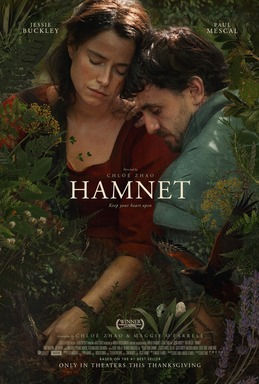
Chloé Zhao’s 2025 film Hamnet, which released in India in March 2026, starts with a quote about how the names Hamnet and Hamlet were interchangeable in the Elizabethan age. The quote frames the viewing experience — we’re supposed to understand Hamlet as a deeply personal, and painful and cathartic, play for Shakespeare. Shakespearean scholars warn strictly about the risks of reading his works as biographical and drawing conclusions about the man, his personality and life from his works. Because that’s the nature of art. One can’t really draw inferences about the artist from their art. So from the beginning, I chose to view this film as a fictional interpretation of the playwright’s life.
It’s dangerous to make assumptions about the man based on his works, but also deeply tempting for many readers. One reads his sonnets — which were commissioned to him to convince a young man to get married, where Shakespeare applies the strategy of praising the boy’s beauty in a bid to get him to get married and procreate so his beauty may continue — and draws conclusions about his sexuality. Shakespeare wrote such beautiful, metaphorical, romantic poetry for a young man. So he must have been gay, or bisexual! Perhaps, since sexuality was more fluid at the time, he did feel attraction toward men too. Perhaps, staying in London, far from his wife and kids, he engaged in sexual relations with others, men included. It would be deeply exciting to learn that Shakespeare was part of the LGBTQ+ community. But this cannot be concluded just from reading his sonnets.
Perhaps he was simply writing sonnets to make money, and the effect of his writing upon our minds is a testament to his brilliance as a writer. Similarly, it’s possible that Shakespeare’s Hamlet was connected to the death of his son Hamnet. But this cannot be known with certainty. So Hamnet must be watched carefully. With the awareness that we’re entering Chloé Zhao’s fictional, interpretive world. And now that that disclaimer has been issued, the film itself is a visual and emotional treat.
It opens with Jessie Buckley, who plays Agnes, lying on the forest floor. The forest is serene, breathtaking, almost too perfect. It holds mysteries and secrets and nature’s dark side is hinted at slightly, but mostly the forest is a stand in for Agnes’ mother, who passed away when Agnes was still a child. After she marries Will and is ready to deliver their first child Susanna, Agnes walks into the forest, lays down under a wise and caring tree, and delivers her baby girl. As the three children grow up, Agnes passes on her knowledge of the forest to them. When her second daughter, Judith, falls ill, she uses herbs and natural remedies to nurse her back to health. The forest isn’t just a supporting character, it’s an elder in the family, it’s their home, it’s their guardian, it’s their witness. Stratford’s wilderness helps set the Shakespeare family apart, signals that Agnes is a different woman from the rest, that Will has greater aspirations than taking on a trade. The forest is a reminder that this couple, and this family, don’t fit into society and its ways. They’re built different.
With this established, the film settles into a storytelling about the couple’s life. Will is tortured and slowly becoming a broken man. Agnes finds that the best way to save him is to send him off to London, where he can experience a broader world, and perhaps find himself. Zhao gives Agnes that agency. It’s not Will who decides to go, it’s Agnes who decides to send him. The film, up until the last few scenes, focuses also largely on Agnes. And Jessie Buckley does a spectacular job of bringing Zhao’s Agnes to life. She breaks down when she’s delivering her twins, screams when she loses her son, rages at Will for not being around when their son was parting, finds release through watching Hamlet being performed in London. She carries big emotions on her face, her eyes talk of all the experiences behind those emotions and her body cooperates, as though she’s allowing each emotion to course entirely through all of her. She works as an instrument, embodying and expressing the character’s inner world with a delicate expertise. In essence, the actor understands the depth and responsibility of being an actor. It’s no surprise that Buckley won the 98th Academy Award for Best Actress in a Leading Role for her role in the film.
After Hamnet’s death, once Will is back in London, Agnes hears that his latest play is a tragedy called Hamlet. She makes her way to the playhouse to see her son. Hamlet comes on stage, a young prince with curly blonde hair and a round face, and Agnes exclaims. Her son is there. Will comes out on stage as the ghost, telling Hamlet about what happened to him. For Agnes, this is her husband’s way of taking their son’s place, tricking death into taking him instead of Hamnet, the way Hamnet tricked death into taking him instead of his twin. Agnes accepts Will’s sentiment with a smile. On stage, as Hamlet valiantly participates in a sword fight, Hamnet’s words echo in the viewers’ minds — he would grow up and join Will in London and be the fiercest sword fighter. Agnes smiles. Towards the end, as Hamlet is dying, Agnes reaches out and holds his hand. As does the rest of the audience. Agnes laughs to herself. And then she sobers down, but her burden has lessened. Seeing her son on stage has healed something in her. Her relationship with her husband, one can assume, will be at least slightly mended now. Hamlet has allowed Agnes catharsis, it’s allowed her closure and it’s allowed her happiness.
Shakespeare’s words have that effect. While most of the film is set in Stratford, it ends in the London playhouse. While most of the film focuses on Agnes’ inner world, at the end, that focus is shared with Shakespeare’s words. In the end, it’s his writing that emerges as the hero. Earlier in the film, he’s tortured and confused, but going to London and writing gives him his sense of self. And at the end, his writing heals some of the fissures his wife is carrying. While it’s a testament to Shakespeare’s writing, it’s also a reminder about the importance of art. Art saves. Art heals. Art makes room for love. And if the art in question is Shakespeare, it’s beautiful all the while.

Comments